

Last Updated: November 11, 2026
Quick Summary
Measure author platform reach and influence by tracking engagement depth, audience ownership, and commercial action instead of follower counts. Watch comments, shares, saves, email open and reply rates, discovery calls, speaking inquiries, and book sales to see what readers actually do next.
- Reach is how many people see you; influence is how many act because of you.
- An author with 4,000 engaged readers can outperform one with 40,000 passive followers.
- Treat every single-channel number as a directional signal, not a verdict.
- A list of 2,000 readers with steady opens and replies beats a 20,000-person list that never clicks.
- Use a quarterly rhythm and compare against your own last quarter, not someone else's feed.
Table of Contents
- Why Follower Counts Fail as a Measure of Author Platform Reach
- The Metrics That Actually Reveal Author Platform Influence
- How Author Platform Analytics Tools Turn Activity Into Insight
- Reading the Signals in Your Author Email List Engagement
- Book Marketing Metrics for Consultants: From Downloads to Discovery Calls
- How to Track Leads From Book Marketing Without Guessing
- Building a Measurement Rhythm That Connects Reach to Revenue
- Turn Your Platform Data Into Your Next Publishing Decision
- Frequently Asked Questions
Why Follower Counts Fail as a Measure of Author Platform Reach
A large following feels like proof of influence. It rarely is. If you want to measure author platform reach and influence honestly, start by admitting that follower totals tell you almost nothing about whether your book will sell or your practice will grow.
Reach and influence are different things. Reach is how many people see you. Influence is how many act because of you. At Leadership Books, we have watched capable authors celebrate a five-figure following while their book launch produced a handful of real client conversations.
The numbers back up the skepticism. A 2026 measurement guide recommends tracking engagement per post, shares, saves, retention, topic share, and sales instead of leaning on follower counts (Somin's guide to measuring social media influence beyond follower counts).
So what should you watch instead? The signals that map to real outcomes:
- Replies and messages that start conversations
- Email subscribers who open more than one issue
- Readers who ask about working with you
- Speaking invitations that arrive without a pitch
If your platform is wide but quiet, you have reach without influence. For a closer look at choosing between high-value clients and broad amplification, read Secure High-Value Clients vs Amplify Your Voice for Author Platforms. That is the problem worth solving.
The Metrics That Actually Reveal Author Platform Influence
Author platform influence is the measurable effect your work has on what readers do next, not how many people follow you. The strongest evidence combines engagement depth, audience ownership, and commercial action.
Platform-level reach figures are enormous, but they describe the size of the room, not your standing in it. An author with 4,000 engaged readers can outperform one with 40,000 passive followers.
We group the signals that matter into three tiers:
| Signal type | What to track | Why it matters |
|---|---|---|
| Attention | Comments, shares, saves, watch time | Shows content earns response, not just views |
| Ownership | Email open rate, replies, list growth | You control this channel directly |
| Action | Discovery calls, speaking inquiries, book sales | Connects platform work to revenue |
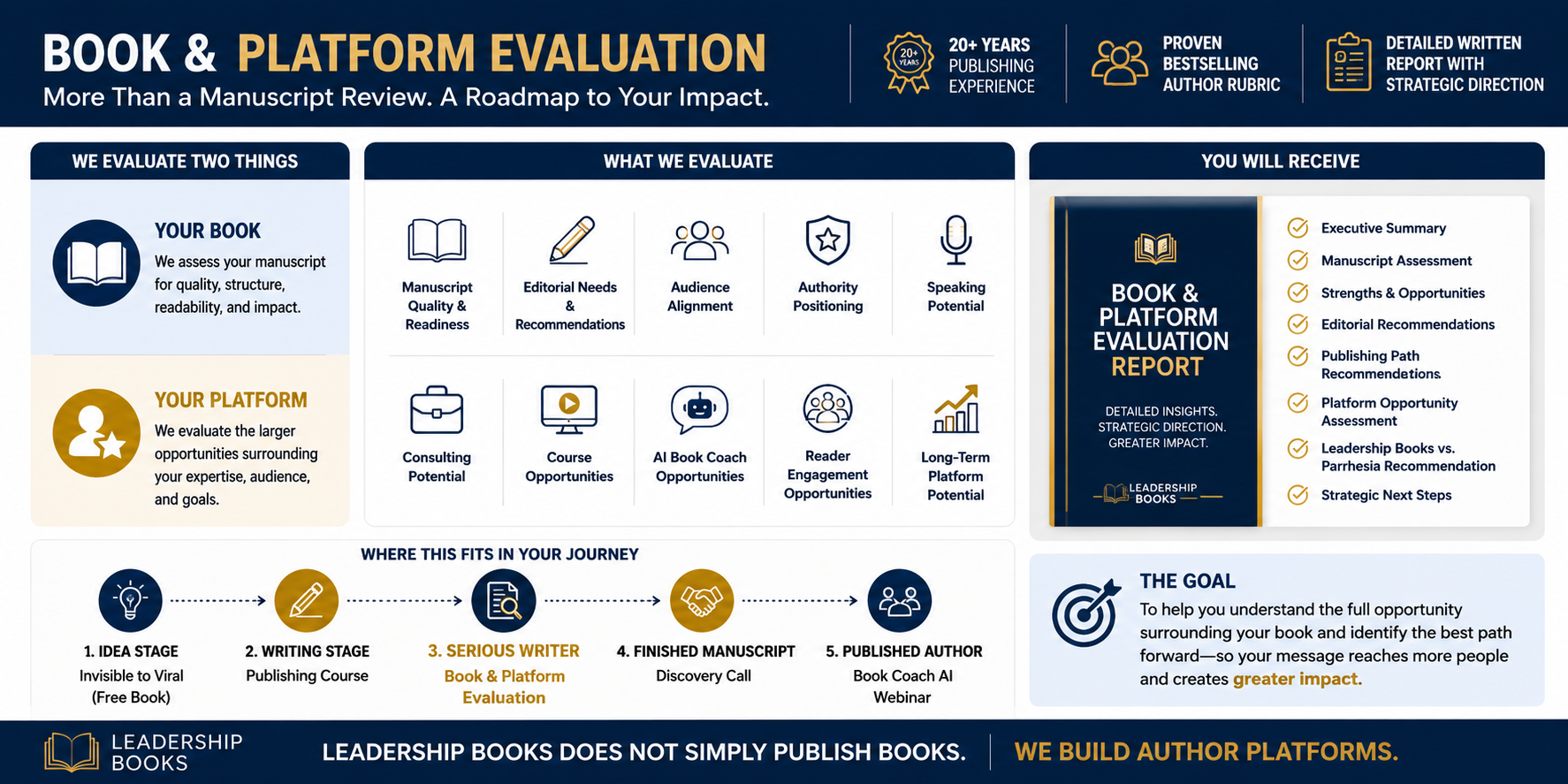
If you want an outside read on how your book and platform measure up, a book and platform evaluation reviews manuscript readiness alongside audience alignment, speaking potential, and long-term platform opportunity.
How Author Platform Analytics Tools Turn Activity Into Insight
Author platform analytics tools are the dashboards and reports that pull your social, email, and website data into one view. They convert scattered activity into patterns you can act on.

Most authors do not need a paid analytics platform on day one.
Here is a simple way to think about the tool categories:
- Email platform analytics (your provider's built-in reports): strongest for open rate, reply rate, click rate, and list growth. This is your ownership layer.
- Website analytics (such as a standard site analytics install): shows which pages convert visitors into subscribers or calls, and which traffic sources actually send people who stay.
- Social native analytics: useful for saves, shares, comments, and watch time, but limited because each platform measures differently and none of them see your revenue.
- A manual tracking sheet: the only place where all three layers meet your discovery calls and book sales. Unglamorous, and usually the most honest view you will get.
A common pattern among consultants and coaches is to over-invest in the social dashboard and under-invest in the sheet that connects channels to clients. The dashboard tells you a post performed well.
When you evaluate a paid tool, ask three questions before you buy. Does it connect email and web data in one place, or just add another silo? Can it tag a contact by source, such as "book reader" or "podcast listener"? Will you actually open it monthly?
Watch out: platform tools measure channels separately, and each one is biased toward its own success. Your email provider counts an open as engagement even when a privacy feature auto-loads the image.
If audience growth is the number you care about most, our article on building a broader author platform audience goes deeper into the tactics behind it.
Reading the Signals in Your Author Email List Engagement
Your email list is the most honest measure of author platform reach you own. Open rates, reply rates, and click patterns show who is actually paying attention.
Social platforms can change their rules overnight. Your list cannot be taken away. That is why we treat email engagement as the primary signal, not a secondary one.
Watch these three numbers each month:
- Open rate: Are the same people still reading?
- Reply rate: Are readers talking back to you?
- Click rate: Do readers want the next step you offer?
A list of 2,000 readers with steady opens and regular replies beats a 20,000-person list that never clicks. Written Word Media's 2026 Mid-Year Indie Author Survey, which surveyed 566 authors, examined strategies driving growth including newsletters, though the published summary does not report specific findings (Written Word Media's 2026 mid-year indie author survey).
One caution: open rates are less precise than they once were because of privacy features in email apps. Treat them as a direction, not a verdict.
Book Marketing Metrics for Consultants: From Downloads to Discovery Calls
For consultants and coaches, the only book marketing metric that ultimately counts is qualified leads. Everything else is a leading indicator.
We track a simple funnel. Each stage has one number, and the drop-off between stages tells you where to work.
| Funnel stage | Metric to watch | What a weak number tells you |
|---|---|---|
| Discovery | Book downloads and sample requests | Your topic or description is not landing |
| Engagement | Email sign-ups from the book | The call to action inside the book is weak |
| Nurture | Email open and reply rates | Your follow-up content is not relevant |
| Conversion | Discovery calls booked | Your offer or positioning needs work |
The gap most authors miss sits between engagement and conversion. A reader finishes your book, feels inspired, and then has nowhere specific to go. Fix that with one clear next step: a short call, a workshop, or a downloadable assessment.
This is where a book earns its keep as a business asset. It builds authority, and authority shortens the sales conversation.
How to Track Leads From Book Marketing Without Guessing
Tracking leads from book marketing requires a link between the book and your follow-up system. Refining this attribution process transforms vague interest into actionable data, a methodology explored further at CGT Marketing LLC.
The mechanics are less complicated than they sound:
- Place one call to action in the book, repeated in the final chapter and in the about-the-author page.
- Send that call to action to a dedicated landing page, not your homepage.
- Offer something specific in exchange for an email address, such as a short assessment, a workbook chapter, or a workshop invitation.
- Tag every new contact with the source, such as "book reader," "podcast," or "speaking event."
- Ask one question on the first call: "How did you hear about us?"
That last step is the most reliable attribution tool available.
Where authors get stuck is channel choice. Not every channel deserves equal effort, and the right mix depends on your audience size, your budget, and your career stage. A rough way to prioritize:
- Email list: highest control, lowest cost per contact, best for nurture. Start here if you have any list at all.
- Podcast guesting: strong for borrowed trust and for reaching warm audiences, but slow to schedule and hard to attribute without a dedicated landing page per appearance.
- LinkedIn and similar professional networks: good for consultants and coaches whose buyers are there, weaker for consumer nonfiction.
- Live events and workshops: highest conversion per conversation, highest time cost. Best once you have a clear offer.
- Partnerships and referrals: often the strongest source of qualified leads, and the easiest to under-track because they arrive through a personal introduction.
- Paid promotion: useful for testing a message or a cover, rarely the first lever for a new author without a proven funnel.
A tiered plan helps you choose realistically.
Attribution has trade-offs worth naming. Last-click tracking will over-credit the landing page and under-credit the podcast that sent the reader. Self-reported answers catch what dashboards miss but depend on people remembering.
Watch out: authors often build the landing page and then forget to mention it in the book itself. The page sits empty while readers finish the last chapter and move on.
This is where a book earns its keep as a business asset. It builds authority, authority shortens the sales conversation, and a tracked next step turns a finished reader into a booked call.
Building a Measurement Rhythm That Connects Reach to Revenue
A monthly review turns platform data into decisions. Pick one day each month, open your four numbers, and ask one question: what changed, and why?
Before you tie metrics to revenue, it helps to settle a bigger question about whether a book actually builds authority at all. Our article on whether publishing a book really builds authority covers that groundwork.
We suggest a quarterly rhythm instead of weekly checking. Weekly numbers bounce around and tempt you to react to noise. Quarterly trends show what is working.
Three habits keep the rhythm honest:
- Write down your numbers, so memory cannot flatter you
- Compare against your own last quarter, not someone else's feed
- Ask three readers each quarter how they found you
Turn Your Platform Data Into Your Next Publishing Decision
Your platform data is only useful if it changes what you do next. That might mean adjusting your topic, your offer, or the way you describe your book.
If you are ready to put measurement into a launch plan, the Book Launch Mastermind walks through building a launch team, a buyer list, and outreach scripts. Your book can be the beginning of something bigger. Watch Beyond the Book to explore what comes next.

The authors who grow fastest are the ones who stop counting followers and start counting conversations. Leadership Books helps authors build platforms that produce real opportunities, with a Modern Publishing model that keeps 100% of your rights in your hands, generous royalties, and strategic marketing support behind your launch. Get started with Leadership Books and turn your book into a platform that earns attention you can measure.
Frequently Asked Questions
How do you measure an author platform's reach?
Reach is the number of distinct people who see your content, not the number who follow you. Pull reach data from each channel's native analytics, then combine it with email list size and open rates. Track reach monthly across social, email, and search so you can spot which channel actually puts your ideas in front of new readers.
Which metrics matter most for an author platform?
Engagement per post, shares, saves, retention, topic share, and sales tell you more than follower totals. Measurement practitioners recommend exactly this shift away from vanity counts. For consultants and coaches, add email open and click rates, discovery call bookings, and speaking inquiries. These are the book marketing metrics for consultants that connect platform activity to business outcomes rather than applause.
How can authors measure influence beyond social media followers?
Look at what people do after they see your work. Track email replies, direct messages asking about your services, podcast invitations, speaking requests, and consultation bookings. Metrics often described as measuring influence can instead measure sharing likelihood and reach, so pair behavioral signals with revenue data. If your follower count grows but inquiries stay flat, your influence is not converting into opportunity.
How do you track whether book marketing generates leads?
Use a dedicated landing page and tagged links in every campaign so you can see which source produced each inquiry. Ask new clients how they found you and log the answer. Then compare lead volume against the effort behind each channel. This is how to track leads from book marketing without relying on memory or gut feel, and it shows which tactics deserve more budget.

0 comments